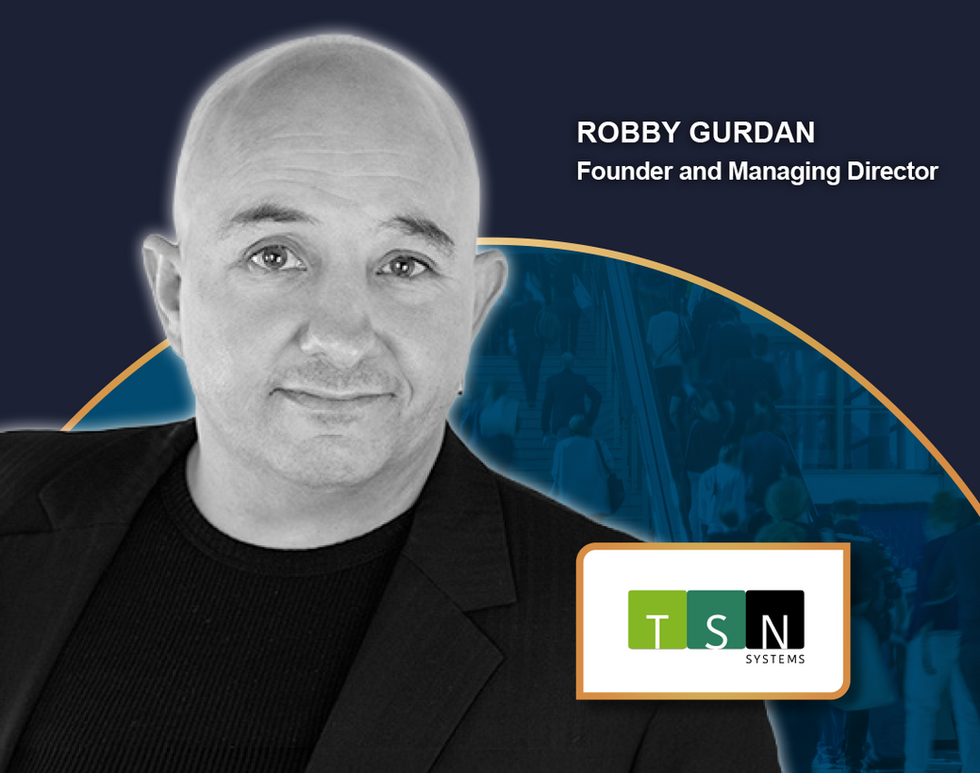
Robby Gurdan is Founder and Managing Director (CTO) of TSN Systems GmbH in Fulda and Founder and Managing Director (CTO) of Uman GmbH in Stuttgart, together with Jürgen Scheuring.
Within TSN Systems, he oversees all product development and is responsible for technical customer consulting, project execution and lead projects for the company's clients, including many of the industry's leading technology companies.
Working at eye level with his teams, he oversees the development of the TSN Systems product portfolio, designed to remain at the cutting edge while meeting the needs of a wide range of individual and corporate customers.
His technical background has also led him to contribute to academia. He serves as a guest lecturer at selected universities and oversees and teaches at the company's TSN Academy, promoting knowledge and expertise across the industry.
In addition to his professional accomplishments, he holds several international patents and is a co-author of AES64-2012, an AES standard for the abstraction and real-time control of audio applications in networks, as well as several academic papers.
Presentation
Validate the Vehicle, Not the Interfaces – End-to-End Correlation Across Ethernet Zone Architectures, CAN, LIN & A²B
Modern vehicle architectures are moving from isolated ECUs and functional domains towards highly interconnected, zone-based networks. As a result, communication that appears stable when tested within a single device or domain may behave very differently once it shares network resources, timing dependencies, gateways and processing paths with the rest of the vehicle.
Traditional device- and domain-centric validation therefore no longer provides sufficient assurance for pre-SDV and SDV architectures. Validation must evolve towards a system-level approach that observes Ethernet, CAN, LIN and other communication simultaneously and correlates all relevant data on a common time base.
Only by reconstructing the interaction between distributed traffic, events and processing delays can engineers identify where congestion, timing shifts, dependencies or unexpected interference originate. The objective is no longer simply to prove that each component works—it is to prove that the complete vehicle works as one interconnected system under realistic load conditions.